Creative Chat Wireless Business Headset Specs, Features, and Value: Is it worth the price tag?
The Creative Chat Wireless Business Headset aims to balance professional call performance with the comfort and convenience expected from modern wireless headsets. Marketed toward remote workers, call center agents, and professionals who spend long stretches on audio calls, the Creative Chat positions itself as a practical alternative to established enterprise headsets. This article examines the headset in detail—covering specifications, real-world performance, strengths and trade-offs—so prospective buyers can decide whether it meets their needs and justifies its price.
Introduction
In recent years, the market for business-focused wireless headsets has matured. Buyers prioritize clear voice transmission, reliable wireless connections, long battery life, and comfortable designs that can endure extended use. Beyond these core expectations, additional considerations include platform certification (for Teams, Zoom, etc.), multi-device pairing, and robust noise suppression for both users and callers on the far end.
The Creative Chat Wireless Business Headset targets this segment. It promises wireless convenience, a noise-canceling microphone, and all-day comfort. This review breaks down the technical specifications and features, evaluates performance in everyday scenarios, compares the headset to typical competitors, and gives a practical buying guide to help readers decide if it is the right pick.
Detailed Product Review and Analysis
Design and build quality
The Creative Chat follows a business-oriented aesthetic that emphasizes understatement and ergonomics. The earcups and headband use soft padding for extended wear comfort, and the clamping force is tuned to stay secure without excessive pressure. Construction primarily relies on ABS plastic to keep weight down while maintaining sufficient durability for daily use. The overall feel is light and unobtrusive, which is important for professionals who wear a headset for hours.
Audio performance (speaker)
Audio tuning on the Creative Chat emphasizes voice clarity over deep bass or wide stereo imaging, which aligns with its business focus. For conference calls and voice chat, the headset produces clear midrange frequencies where human speech lives, so colleagues and clients tend to sound natural and intelligible. Music and media playback are adequate for background listening, but audiophiles should not expect high-fidelity sound comparable to dedicated consumer headphones.
Microphone and voice quality
The microphone uses active noise suppression algorithms and a close-proximity boom design to isolate the speaker's voice. In quiet home-office conditions, callers report crisp, intelligible speech with minimal room ambience. In noisier environments—such as open-plan offices or busy household spaces—the mic's noise reduction reduces background hum and keyboard noise, though very loud transient noises (sirens, dogs barking nearby) may still leak through. For most business users, the microphone delivers reliable, professional-sounding calls.
Wireless connectivity and range
The Creative Chat supports wireless connectivity through a dedicated USB dongle (often operating on 2.4 GHz) and may also offer Bluetooth for connecting to mobile devices. The 2.4 GHz dongle provides lower latency and a stable link to desktop systems—especially valuable for VoIP and softphone use—while Bluetooth adds flexibility for taking calls from a smartphone or tablet. In typical home and office settings, the effective range is sufficient for moving within a conference room or home office; walls and sources of interference can reduce range, as with any wireless headset.
Battery life and charging
Battery endurance is an essential metric for business headsets. The Creative Chat delivers all-day battery life under moderate call loads, with quick top-ups possible via USB charging. Actual battery longevity depends on microphone usage and active noise features; users engaged in continuous conference calls can expect shorter durations than those using the headset intermittently. The headset typically includes power-saving modes to extend standby time.
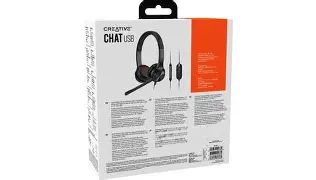
Comfort and ergonomics
Comfort is a strong point: the ear cushions are breathable and the headband distributes weight evenly, reducing pressure on temples and ears. The headset's swivel earcups and adjustable headband help achieve a precise fit for a range of head sizes. For single-ear (mono) and dual-ear (stereo) variants, the choice comes down to personal workflow: single-ear models keep one ear free to monitor the environment; dual-ear models isolate better for noisy settings.
Software and integrations
Creative may provide companion software for firmware updates and call management, though many users will rely on the headset's plug-and-play behavior. Platform certification—such as for Microsoft Teams, Google Meet, or Zoom—matters for enterprise deployments because it ensures compatible call controls and presence integration. Buyers should verify whether their chosen Creative Chat model includes such certification if it is important for their workflow.
Security and manageability
For organizations, security and manageability can be decisive. A dedicated USB dongle simplifies provisioning in large fleets but can be an administrative overhead if IT needs to track devices. Bluetooth pairing provides more convenience but may be less desirable for managed endpoints. The Creative Chat's wireless protocols should offer secure pairing and encryption; however, enterprises with strict policies should confirm compliance with their IT security requirements.
Looking for the best Electronics deals on Amazon?
View Offers →Durability and warranty
Everyday durability is acceptable for office use: the headset resists light knocks and routine handling but is not designed for rugged environments. Warranty terms and customer support quality vary by region; buyers should check local support options and warranty length if long-term reliability is a priority.
Pros & Cons
- Pros:
- Clear voice-oriented audio tuning suited to calls and conferences
- Noise-suppressing microphone for cleaner remote voice pickup
- Lightweight, comfortable design for extended wear
- Dedicated USB dongle for stable desk connectivity and low latency
- Bluetooth support for mobile flexibility (on applicable models)
- Cons:
- Audio fidelity is optimized for voice rather than music playback
- Not a ruggedized device — may not suit heavy industrial use
- Advanced platform certifications are model-dependent and may be absent
- Very loud environmental noises can still reach the microphone
Comparison: Creative Chat vs Typical Competitors
To put value into context, compare the Creative Chat's common attributes against representative offerings in the business headset space.
| Feature | Creative Chat | Common Competitor (e.g., enterprise-focused models) | Notes |
|---|---|---|---|
| Primary focus | Voice clarity for business calls | Voice + enterprise manageability | Both prioritize speech; competitors may offer more admin tools |
| Wireless options | USB dongle + Bluetooth (varies) | DECT or USB dongle + Bluetooth | DECT offers longer range and less interference in crowded Wi‑Fi environments |
| Noise cancellation (mic) | Active noise suppression | Advanced multi-mic ANC and adaptive algorithms | Competitors may outperform in extremely noisy settings |
| Battery life | All-day typical use | All-day to multi-day depending on model | Battery life varies with active features and call patterns |
| Platform certification | Model-dependent | Often available (Microsoft, Zoom, etc.) | Certifications simplify integration for enterprise IT |
| Price/value positioning | Mid-range business segment | Ranges from mid to premium | Creative Chat offers a practical balance for budget-conscious buyers |
Real-world Use Cases
The Creative Chat is well-suited for:
- Remote professionals and freelancers: Individuals who spend hours on video calls and value comfort, straightforward pairing, and a reliable microphone.
- Small office settings: Teams without complex device management needs that want a plug-and-play wireless solution.
- Hybrid workers: Users who switch between laptop and mobile calls and appreciate Bluetooth alongside a low-latency USB connection.
- Customer service and support agents (light to moderate volumes): Environments where speech clarity and noise reduction matter but where enterprise provisioning is not required.
Scenarios where the Creative Chat may be less ideal include very noisy call-center floors with dozens of simultaneous agents (where advanced noise suppression and DECT may be preferable) and audio professionals who need high-fidelity music playback.
Buying Guide: What to Consider Before Purchasing
When evaluating the Creative Chat or any business headset, these factors determine whether the model will meet a buyer's needs.
1. Intended primary use
Decide whether the headset will be used mostly for voice calls, occasional media playback, or both. The Creative Chat favors voice; buyers who prioritize music quality should consider consumer-grade headphones instead.
2. Connectivity and device ecosystem
Check whether the model supports a USB dongle, Bluetooth, or DECT. USB dongles reduce latency and simplify PC connections; Bluetooth enables easy phone pairing. For IT-managed deployments, confirm compatibility with endpoint management practices.
3. Microphone performance and noise suppression
Evaluate how important background noise reduction is in the buyer’s environment. If calls occur in busy spaces, seek models with proven multi-microphone arrays and strong ANC. For quieter home offices, standard noise suppression like that in the Creative Chat is often sufficient.
4. Battery life and charging
Estimate average daily usage to determine required battery capacity. Confirm charging methods (USB-C is preferred for convenience) and whether the headset supports quick charge to minimize downtime.
5. Comfort and fit
Look for adjustable headbands, breathable ear cushions, and lightweight construction. If possible, test the headset for at least an hour to check for pressure points or heat build-up on the ears.
Find top-rated Electronics products at great prices.
View Offers →6. Platform certification and call controls
For organizations using specific conferencing platforms, certification ensures integrated call controls and compatibility. Confirm whether call answer/end, mute, and volume controls behave as expected with the chosen software.
7. Manageability and security
Enterprises should verify device provisioning, firmware update mechanisms, and wireless security. A dedicated admin or IT portal can simplify fleet management if many units will be deployed.
8. Warranty, support, and return policy
Check local warranty terms and support responsiveness. A straightforward return policy is useful for testing comfort and sound in the buyer’s environment.
9. Price versus features
Assess whether the headset’s features match the price point. The Creative Chat is positioned toward professionals seeking voice-first performance without premium enterprise management features—appropriate for buyers prioritizing value over bells and whistles.
Practical Tips for Getting the Best Performance
- Place the USB dongle on a desktop USB extension if signal issues occur when the dongle is blocked by a PC chassis.
- Keep firmware updated to benefit from microphone and battery optimizations.
- Use mono (single-ear) or stereo (dual-ear) variants depending on need to hear ambient sound or block distractions.
- Pair the headset via Bluetooth for mobile calls and use the dongle for laptop conferencing to minimize latency.
- Test the headset with the actual conferencing software commonly used to ensure button mapping and mute behavior match expectations.
Value Assessment: Is the Creative Chat Worth the Price?
Value is relative to the buyer’s priorities. For professionals who need a comfortable, voice-optimized headset that delivers reliable call quality and the convenience of wireless connectivity, the Creative Chat represents solid value. It strikes a pragmatic balance: strong microphone performance, stable desk connectivity through a USB dongle, and everyday comfort—all of which address the main pain points of remote work and small-office setups.
However, buyers with specific enterprise needs—such as large-scale device management, DECT range requirements, or the highest possible noise-cancellation in chaotic environments—may find higher-end competitor models better suited to those scenarios. Similarly, those seeking exceptional music fidelity will likely find the Creative Chat's voice orientation limiting.
Conclusion
The Creative Chat Wireless Business Headset is a thoughtfully designed option for professionals whose core requirement is clear, reliable voice communication combined with comfortable daily wear. Its strengths lie in microphone clarity, lightweight ergonomics, and practical wireless connectivity options. It is particularly appropriate for remote workers, hybrid professionals, and small-business users who want dependable performance without enterprise-grade provisioning.
Ultimately, the headset's worth depends on how closely its feature set aligns with the buyer's real-world use cases. For voice-centric workflows and users who value comfort and straightforward setup, the Creative Chat delivers a compelling combination of features and usability. For environments with extreme noise, large-scale IT management needs, or premium audio demands, buyers should carefully compare alternatives to ensure they select the best fit for their specific requirements.