A Professional's Take on the New Ecotank Et 4850
Introduction
The Ecotank Et 4850 represents the latest continuation of the refillable-ink, low-cost-per-page approach that has reshaped expectations for home and small-office printers. Rather than competing primarily on headline print speeds or glossy marketing, this class of device targets total cost of ownership, predictable running costs, and convenience for users who print regularly. This review examines the ET 4850 from a professional perspective: design and ergonomics, ink and consumables economics, print quality and reliability, and how the machine performs in real-world scenarios buyers typically face.
Product overview and key features
The ET 4850 is positioned as an all-in-one ink-tank printer for households and small businesses that require moderate-to-high monthly print volumes. At its core are refillable ink reservoirs that replace cartridges, an integrated scanning bed with multi-page handling, and modern connectivity options such as Wi‑Fi and mobile printing. The model emphasizes predictable operating costs and reduced waste while retaining the features that make an all-in-one useful in an office setting.
- Refillable ink tanks: Large, front-facing reservoirs with color-coded inlets for easy refilling and visible levels.
- All-in-one functionality: Flatbed scanner plus automatic document feeder (ADF) for multi-page scans and copies.
- Duplex printing: Automatic double-sided printing to save paper on multi-page documents.
- Wireless and mobile printing: Wi‑Fi, Wi‑Fi Direct, and common mobile-printing protocols for printing from phones and tablets.
- Low running cost focus: Bundled ink bottles sized to deliver thousands of pages before refilling is needed.
In-depth analysis
Design and build quality
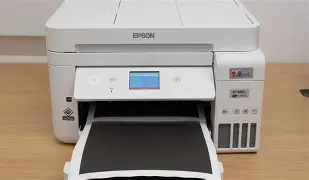
The ET 4850 adopts a pragmatic, no-frills aesthetic common to utility-focused devices. Surfaces are mostly matte plastic with a compact footprint that balances tank capacity and desktop space. Controls are usually a mix of a small color LCD and physical buttons, which keeps simple tasks straightforward without overcomplicating the interface.
From a professional viewpoint, the design prioritizes serviceability: refill ports are accessible from the front, paper trays are easy to load, and the ADF lifts cleanly for occasional scanner maintenance. The machine's size makes it a good fit for small workspaces where floor space is limited but an integrated scanner and multi-page handling are needed.
Ink system and total cost of ownership
The principal selling point of the ET 4850 is the ink-tank system. Instead of replaceable cartridges with fixed page yields, large bottles refill the integrated tanks. This translates to a significantly lower cost per page for most office print mixes, especially for black text and mixed color documents.
Professionals assessing total cost should consider both the upfront price of the printer and the effective yield of the ink bottles. For organizations that print monthly reports, internal memos, invoices, or labels, the refillable approach reduces frequency of consumable purchases and the administrative friction of managing cartridge inventories.
Environmentally, refillable tanks reduce plastic waste relative to cartridge replacement cycles; however, buyers should still factor in proper disposal or recycling of the remaining ink bottles and occasional maintenance parts such as print-head cleaners.
Print quality
On text documents, the ET 4850 performs strongly: black text is crisp at standard office sizes, and small fonts remain legible during multi-page print runs. For color documents such as charts, graphs, and brochures intended for internal distribution, the device produces acceptable color saturation and contrast.
Find top-rated Electronics products at great prices.
View Offers →Photographic output will not match a dedicated photo inkjet or a dye-sublimation printer. Colors can be slightly less saturated, and fine tonal gradations are not as smooth on standard office paper. That said, when paired with photo paper and careful color management, the ET 4850 can deliver passable snapshots and illustrative images for presentations.
Speed and performance
In everyday tasks, the ET 4850 offers reliable throughput. First-page-out times are competitive for ink-based devices in this class, and moderate print jobs complete without overheating or significant slowdown. The ADF and automatic duplexing improve productivity for multi-page workflows, notably when scanning or copying multi-page documents.
Network printing performance depends on the local environment. Over a stable Wi‑Fi network, latency is low and mobile printing is convenient. Office environments with dense Wi‑Fi traffic may benefit from connecting to a wired network (if supported) or placing the printer on a dedicated SSID to reduce interference.
Scanning and copying
The integrated flatbed scanner is appropriate for occasional document archiving, form scanning, and image capture. The ADF is valuable for batch scanning of contracts, receipts, and multi-page reports. Scan quality is sufficient for OCR workflows and document management systems, with accurate grayscale rendering and reliable edge detection when scanning stacks of pages.
Copying is straightforward, with reasonable multi-copy speed and basic options for reducing/enlarging or adjusting contrast. For businesses that rely heavily on high-volume scanning (e.g., scanning hundreds of pages daily), a dedicated network scanner would still be preferable; however, for the typical small office, the ET 4850 handles day-to-day needs well.
Connectivity and software
Connectivity options reflect modern expectations: wireless networking, direct mobile printing, and a USB connection for local use. Integration with common operating systems and mobile devices is standard, and bundled software generally includes basic drivers, scanning utilities, and an ink-monitoring app.
IT managers should look for robust driver support and firmware update policies. In mixed-OS environments, confirmation of compatibility with legacy operating systems or server-based print deployments is an important consideration.
Reliability and maintenance
Reliability tends to hinge on proper maintenance and usage patterns. The ET 4850's ink system minimizes wasted ink and reduces the incidence of dried print heads compared with unused cartridge-based machines, provided the unit is used regularly. For infrequent printers, the advice is to perform a small print task weekly to keep nozzles healthy.
Find top-rated Electronics products at great prices.
Shop Amazon →Maintenance tasks such as head cleaning can be triggered through software or the printer panel, and routine cleaning cycles are typically automatic. The design reduces user interaction with the ink path, but professionals should still plan for occasional troubleshooting—particularly if demanding color fidelity or heavy-duty scanning is required.
Real-world use cases
The ET 4850 is particularly well suited to several common scenarios:
- Home or hybrid office: For professionals working from home who print invoices, client letters, and project documents, the low ongoing ink cost reduces monthly expenses while the ADF speeds occasional document scanning.
- Small business with steady volume: Practices such as accounting firms, small law offices, or micro-retailers that generate daily paperwork benefit from predictable ink costs and duplex printing that reduces paper outlay.
- Student or academic use: Students who print assignments and research material will find the refillable model economical across a semester when compared to cartridge-based alternatives.
- Marketing and internal collateral: Departments producing internal flyers, memos, and charts can create color materials quickly without incurring the high color cartridge expense of traditional printers.
- Environmentally-conscious buyers: Organizations seeking to reduce plastic waste and the frequency of consumable shipments may find ink tanks align with procurement sustainability goals.
Pros & Cons
- Pros:
- Significantly lower cost per page compared with cartridge-based printers for regular printing volumes.
- Large ink reserves reduce the frequency of consumable replacement and administrative overhead.
- Integrated ADF and duplexing improve productivity for multi-page jobs.
- Compact, practical design suited to small offices and home workspaces.
- Environmental benefit from reduced cartridge waste.
- Cons:
- Initial purchase price may be higher than entry-level cartridge printers.
- Photo-quality output lags behind specialist photo printers.
- Dependence on manufacturer-supplied ink bottles for optimal performance can limit third-party refill options.
- Not ideal for very high-volume scanning workflows compared to dedicated network scanners.
- Periodic maintenance and head-clean cycles can use ink and create small, hard-to-avoid consumable drain.
How the ET 4850 compares to similar offerings
A brief comparison highlights where an ink-tank all-in-one sits relative to other popular approaches. The table below compares general characteristics across three representative families: the Ecotank ET 4850, a typical Canon MegaTank offering, and a typical HP Smart Tank device. The intention is to help readers compare priorities (running cost, photo output, network features) rather than offer an exhaustive spec sheet.
| Feature | Ecotank ET 4850 | Canon MegaTank (typical) | HP Smart Tank (typical) |
|---|---|---|---|
| Ink system | Refillable integrated tanks, large bottles | Refillable integrated tanks, color-coded bottles | Refillable tanks with easy-fill ports |
| Running cost | Low cost per page; economical for mixed use | Comparable low cost per page; competitive bottle yields | Low cost per page, often similar to other ink-tank brands |
| Print quality (text) | Excellent for office documents | Excellent | Excellent |
| Print quality (photo) | Good for casual photos; not pro-level | Often slightly better color handling with photo modes | Good; some models tuned for better photo output |
| ADF / Scanning | Flatbed + ADF suitable for small-batch scanning | Typically included; varies by model | Typically included on mid-range models |
| Connectivity | Wi‑Fi, mobile printing, USB | Wi‑Fi, mobile printing, USB | Wi‑Fi, mobile printing, some models with Ethernet |
| Best for | Home office & small businesses with steady print needs | Users seeking low ongoing costs with strong photo modes | Buyers wanting low running costs and easy mobile workflows |
Buying guide: What professionals should consider
When evaluating whether the ET 4850 is the right choice, decision-makers should weigh the following factors:
- Monthly print volume: Estimate typical monthly pages. The economics of ink tanks become compelling as monthly page counts rise above occasional use. For very low-volume users, cartridge printers with lower initial cost may make sense despite higher per-page costs.
- Page mix: Consider the proportion of black-and-white documents versus color printing and whether photographic-quality color is required. Ink tanks are excellent for mixed documents and color charts but are not a substitute for a dedicated photo printer when image-critical work is frequent.
- Space and footprint: Confirm that the printer's dimensions and paper tray orientation suit the available workspace. The convenience of front-facing tanks often offsets modest increases in depth compared with cartridge devices.
- Connectivity needs: For shared office environments, wired Ethernet or robust Wi‑Fi performance can be important. Verify support for enterprise network requirements if necessary (e.g., WPA2-Enterprise, static IP, print server compatibility).
- Scanner usage: If frequent, high-volume scanning is a part of the workflow, evaluate ADF duty cycle and scanning speed. For occasional scanning, the integrated ADF and flatbed are typically adequate.
- Service and warranty: Check warranty length, on-site service options (if applicable), and the availability of official support resources in the buyer's region. These factors reduce downtime risk in business-critical environments.
- Consumables availability and logistics: Confirm that replacement ink bottles are readily available locally or via established supply channels, and that lead times will not disrupt operations.
- Operating system and software compatibility: Ensure that drivers and scanning utilities are supported for the organization’s operating systems and document management workflows.
- Environmental and sustainability goals: For organizations tracking sustainability metrics, the reduced plastic waste and fewer shipments associated with ink bottles are a meaningful advantage.
Conclusion
The Ecotank Et 4850 embodies the practical trade-offs that make ink-tank all-in-ones appealing to professionals: lower ongoing ink costs, reduced waste, and useful multi-functionality in a compact package. For small businesses, home offices, and users with steady print volumes, the device offers a predictable ownership experience and strong text performance for everyday documents. Its color output and scanning capabilities are more than adequate for internal marketing material and document archiving, though users with demanding photographic needs or very high-volume scanning workflows should assess dedicated alternatives.
Ultimately, the most decisive factor is the combination of volume and priorities: those seeking long-term savings, convenience, and a smaller environmental footprint will find the ET 4850 aligns well with those objectives. For environments where top-tier photo fidelity or enterprise-grade scan throughput is mandatory, pairing the ET 4850 with specialized equipment may yield the best balance between cost and capability.